Don't Panic Over Shedding:
Understanding Your Hair's Natural Lifecycle

When speaking with clients at Charmin Hair, they often sit in our chair and bring this up straight away:
"I see so much hair on my pillow and in the shower lately!! Is something wrong with me?"
Some clients even tell us, "I'm so scared another strand will fall out that I barely touch, tie, or style my hair anymore."
Seeing a clump of hair in the sink or hairbrush is enough to make anyone panic. But before you stress, take a deep breath. The strands that fall out today were destined to leave anyway. They were already disconnected at the root. Brushing or washing simply releases what was already ready to come off. It won't pull out healthy, firmly rooted hair!
To put your mind at ease: losing roughly 50 to 100 strands a day is a completely normal physiological process. Once you understand the natural lifecycle of your hair, it all makes perfect sense.
1. The Hair Lifecycle: 4 Growth Stages
Our hair seems to grow continuously, but every single strand goes through a cycle of growing, stopping, resting, and shedding.
Stage 1: Anagen (Growing Phase) – About 85% to 90% of your hair is in this stage at any given time. It grows steadily for 3 to 6 years (roughly 1 cm per month), receiving abundant nutrients from the root.
Stage 2: Catagen (Transition Phase) – A 3-to-4-week period where cell division stops and growth halts as the hair prepares to transition into rest.
Stage 3: Telogen (Resting Phase) – Lasting about 3 months, this stage accounts for 10% to 15% of your total hair. The nutrient supply is cut off, and the strand simply rests, loosely anchored in the follicle.
Stage 4: Exogen (Shedding Phase) – A new baby hair begins to grow beneath the follicle, naturally pushing the old, fully matured strand out.
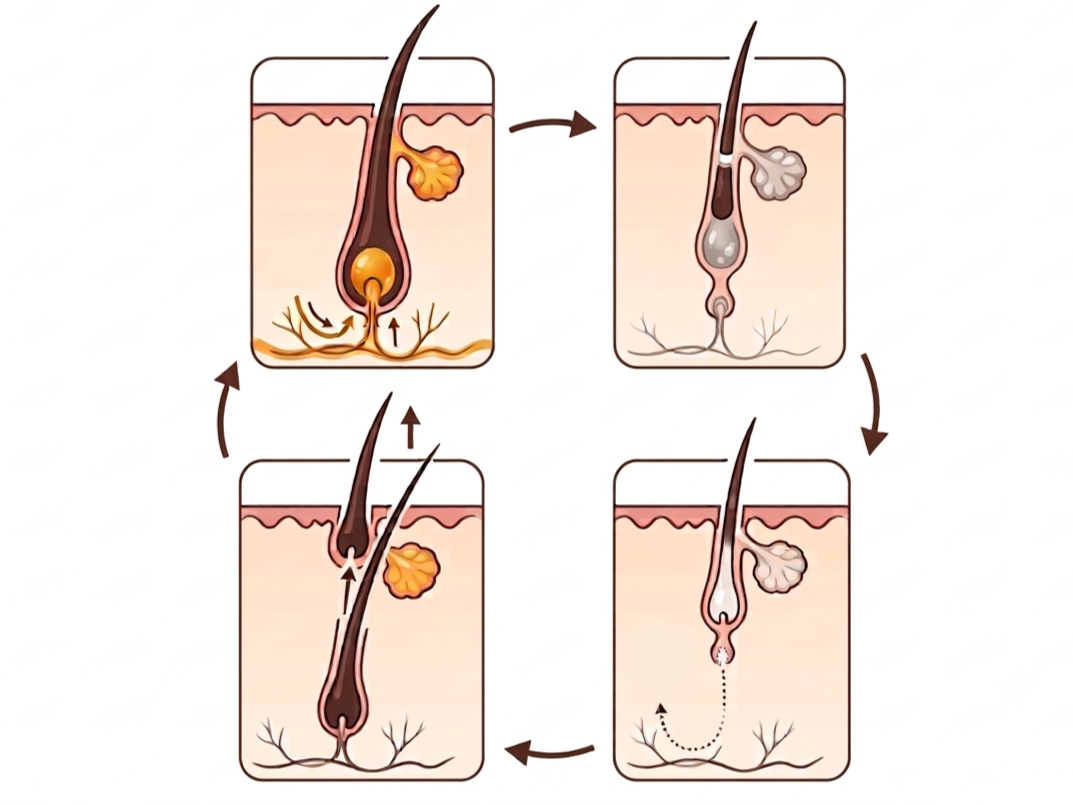
So don't blame yourself or wonder, "Am I doing something wrong?" The strands in your hands today finished their resting phase months ago. It’s not a mistake. just your hair’s natural cycle doing its job.
2. When Does It Become a Real Concern?
"So, is it completely fine no matter how much falls out?"
Here is the main difference: issues arise when the 'Resting Phase' (Telogen) becomes unnaturally prolonged.
On a healthy scalp, as soon as a strand sheds, a new growth-phase hair immediately emerges to fill the gap. However, if the resting phase drags on or an unusually high percentage of hair enters Telogen at once, you may experience:
Dormant Follicles (Gaps): The follicle takes an extended "nap" instead of producing new hair, leaving empty spots where shedding occurred without new growth.
Telogen Effluvium (Excessive Shedding): Growth-phase hair prematurely shifts into the resting phase, resulting in sudden, heavy shedding.
Hair Thinning: Even when new hair eventually emerges after a long resting phase, it grows back fine, weak, and lacking volume.
Ultimately, instead of stressing over the number of fallen strands, focus on these two questions:
"Is new, strong hair growing back in its place?"
"Is my scalp environment healthy enough to wake up dormant follicles?"
3. The Real Solution: How to Wake Up Dormant Follicles
To shorten the resting phase and encourage thick, healthy hair to grow back, you need to care for your hair from both the inside and outside. Here is how to wake up tired follicles:
Nourishing from Within (Inner Care): Over 80% of hair is made of protein (keratin). Supplying key nutrients like biotin, zinc, and brewer's yeast is essential. It also helps to maintain adequate hydration and antioxidant care, supporting healthy microcirculation down to the roots.
Overnight Regeneration (Sleep & Stress): Follicle cells divide and regenerate most actively while you sleep. High stress constricts scalp blood vessels and forces growing hair into the resting phase prematurely, making restful sleep your most powerful preventive care.
Cooling the Scalp & Proper Brushing (External Care): Excess scalp heat fatigues follicles and prolongs the resting phase. Regular scalp massage and proper brushing techniques stimulate blood flow, opening up pathways for nutrients to reach the roots.
Inner nutrition, balanced lifestyle habits, and targeted external care all work together to bring dormant follicles back to life.
Starting today, let go of the guilt and anxiety over falling hair, and embrace a relaxed, proactive approach to healthy scalp care.
4. Airflow and Temperature Control
Hair cuticles are arranged like shingles on a roof, overlapping from root to tip. Directing airflow along this natural slope seals the cuticle layer, allowing light to reflect evenly for maximum shine.
Airflow Angle: Align your hairdryer nozzle parallel to the hair shaft, pointing downwards at a 45-degree angle. This prevents flyaways and smoothes down raised cuticles.
Use Medium Heat: Avoid using the hottest setting directly against your scalp. Opt for a medium temperature setting and maintain a safe distance of 15 to 20 cm. Overly hot air dehydrates the scalp and degrades hair proteins.
The Cool-Shot Finish: Once your hair is roughly 80% dry, switch to the cool air button for the final 20 seconds. True 100% dry hair feels light, airy, and cool to the touch—if it feels heavy or damp, moisture is still trapped inside.
🇦🇺 Tailored Care at Charmin
Understanding your hair's natural cycle is the first step toward long-term scalp health and fuller volume.
If you're experiencing persistent shedding, scalp discomfort, or simply want a personalized home-care regimen, visit us at Chamin Hair in North Sydney. We are always here to help you achieve healthy, effortless hair every day.